Skip to content

Alpaca PBMCs

Alpaca PBMCs and B cells for nanobody/VHH discovery and immunology research. Pick your vial count to see your price now.

  • 10M cells per vial, QC'd for viability and purity
  • Ethically sourced through clinical veterinary partners
  • Full quote including dry-ice shipping within 24 hours
Order PBMCs

Get an instant quote

Species
Alpaca
Your estimate
€700€700 per vial (10M cells)
Product subtotal only - shipping on dry ice is added in your full quote.Need 2M, 5M or 50M cells/vial? Request custom pricing.
Questions? Contact us

Advantages of Using Alpaca PBMCs

There are two primary breeds of alpacas (Lama pacos) used in research: Huacaya and Suri. Huacayas are the more common breed, recognized by their dense, crimped fleece, which gives them a fluffy, woolly appearance. They are generally docile and easier to handle, making them ideal for research settings. Suri alpacas, on the other hand, are distinguished by their long, silky fleece that hangs in distinctive locks.

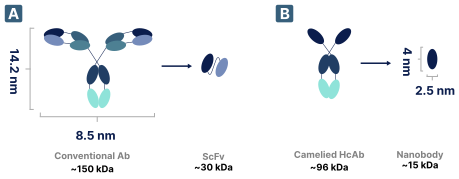
Although less common than Huacayas, Suris, are prized for their luxurious fiber and are selectively bred for this trait.They tend to be rarer and slightly more challenging to handle, requiring specialized care in research environments. While both breeds have traditionally been valued for their high-quality fleece, their unique immune system characteristics have garnered attention in clinical and biomedical research, particularly due to their ability to produce heavy-chain antibodies, or “nanobodies” (Fig.1).

The two primary alpaca breeds used in research: Huacaya and Suri
Fig.1 — Structure of a camelid heavy-chain antibody and derived nanobody
Fig.1 — Camelid heavy-chain antibody and the derived single-domain nanobody.

Key Highlights of Alpaca PBMCs

Alpaca PBMCs are prized for their ability to produce single-domain heavy-chain antibodies — nanobodies — opening unique opportunities across immunoassay development, diagnostics, and structural biology.

Production of Nanobodies

Alpacas, like llamas, produce single-domain antibodies called nanobodies. These are small but stable, highly specific antibodies that are easier to manipulate in vitro. These nanobodies are useful in developing therapeutic and diagnostic tools because of their high affinity and stability.

High Affinity and Stability of Nanobodies

The characteristic structure of alpaca nanobodies enables them to be highly stable and to bind strongly to antigens, even under extreme conditions like very high or very low pH as well as high temperatures, a trait that proves advantageous in drug development and diagnostic assays.

Less Interference in Antibody Production

Thanks to the structure of nanobodies, researchers can generate antibodies with low cross-reactivity, which reduces background interference in immunoassays, allowing for highly specific detection and quantification.

Can Target Concealed Epitopes

Alpaca nanobodies are small enough to reach and bind to special epitopes, including those hidden within complex molecules, which conventional antibodies are unable to access. This quality is especially advantageous when targeting bacterial toxins, viral particles and cancer antigens.

Potent Antigen Recognition

Alpaca-derived nanobodies, once isolated, exhibit longer shelf stability compared to conventional antibodies, reducing the need for frequent sample preparation and enhancing research efficiency in long-term studies.

Ease of Genetic Manipulation

The genetic framework for alpaca immune cells, particularly for single-domain antibodies, allows for efficient genetic engineering, enabling scientists to clone and modify specific antibody sequences for targeted immune studies.

Long Shelf Life and Stability

Alpaca-derived nanobodies, once isolated, exhibit longer shelf stability compared to conventional antibodies, reducing the need for frequent sample preparation and enhancing research efficiency in long-term studies.

Applications in Structural Biology

The small size and high stability of nanobodies from alpaca PBMCs make them excellent tools for structural biology studies, where they can act as crystallization chaperones to facilitate the structural analysis of complex proteins.

Order PBMCs

Ready to order?

See your price instantly and get a full quote including dry-ice shipping within 24 hours.

Get your quote
PBMC Preparation

Alpaca PBMC Preparation

Get in Touch
Animal Blood Collection
STEP 01Animal Blood Collection

As required by institutional and ethical guidelines, the animal is anesthetized before blood collection. Blood collection can be accomplished depending on the size of the animal. For small animals such as rats and mice, blood is typically collected from the tail vein, retro-orbital sinus, or by cardiac puncture. For larger animals such as non-human primates, blood is commonly collected from a vein, mainly the saphenous or femoral vein. To prevent clotting, an anticoagulant is added immediately to the blood. Heparin or EDTA is usually used as anticoagulant. The blood is then gently mixed by inverting the tube several times. Vigorous shaking is avoided to prevent hemolysis.

Dilution of Blood
STEP 02Dilution of Blood

After addition of the coagulant, the blood is diluted with an equal volume of PBS or sterile saline. This step enables the reduction of cell density to facilitate better separation in the gradient. The solution is then gently mixed by inverting the tube.

Density Gradient Centrifugation
STEP 03Density Gradient Centrifugation

A density gradient medium is prepared by adding Ficoll-Paque or Histopaque to a sterile 15 mL or 50 mL centrifuge tube. Approximately 3 mL of density gradient medium per 10 mL of diluted blood is then used. The diluted blood is then layered carefully on top of the density gradient medium. By adding blood along the side of the tube using a pipette, mixing of the mixture is avoided. Next, the mixture is centrifuged at 400 x g for 20-30 minutes at room temperature. Gentle layer separation is ensured by not using the centrifuge brake.

Collection of PBMC Layer
STEP 04Collection of PBMC Layer

The PBMC layer is identified based on its position alongside three other components. The top layer is composed of plasma. The second layer is thin and white, representing the PBMC layer. The third layer is made up of the density gradient medium which is either Ficoll or Histopaque. Finally, the fourth and bottom layer is composed of red blood cells. The second layer, which is the PBMC layer, is carefully harvested using a pipette and then transferred into a new, clean 15 mL centrifuged tube.

Washing the PBMCs
STEP 05Washing the PBMCs

Once the PBMCs have been collected, PBS or culture medium is added to dilute the Ficoll or Histopaque. Next, the solution is centrifuged at 300 x g for 10 minutes at room temperature to pellet the PBMCs. After discarding the supernatant, the cell pellet is gently resuspended in fresh PBS or culture medium. This is followed by two more steps of washing to make sure no Ficoll/Histopaque and other contaminants remain.

Counting and Viability Assessment
STEP 06Counting and Viability Assessment

To measure viability, cells are first counted using a hemocytometer or an automated cell counter. The cell concentration can be adjusted depending on downstream experiment requirements. Then, cell viability assessment is performed using trypan blue staining or another similar method. Ideally, the viability of PBMCs for functional assays should be above 90%.

Storage / Immediate Use
STEP 07Storage / Immediate Use

If the freshly collected PBMCs are to be used immediately, cells are resuspended in an appropriate medium or buffer for further processing for techniques such as flow cytometry, cell culture, etc. If the PBMCs are to be stored for later use, the cells are frozen in a cryoprotective medium such as 10% DMSO in fetal bovine serum and then gradually cooled to -80°C before transferring to liquid nitrogen for long-term storage. We cryopreserve the cells in serum-free cryopreservation media to prevent potential effects of growth factors before and during international shipping.

Alpaca PBMC-Based Assays

Alpaca PBMCs are a route to camelid heavy-chain-only antibodies (VHH / nanobodies): their B-cells are a common starting point for single-domain antibody discovery and immune-library generation. That makes them valuable well beyond standard immune-function assays.

Animal PBMCs are also commonly used in preclinical Safety, Toxicology and Translational research to help select the right in vivo model for late preclinical studies.

The following are common PBMC-based assays in preclinical research.

Alpaca PBMC-based assays

Common Assays

This assay quantifies and analyzes various immune cell subsets within PBMCs, such as T cells, B cells, NK cells, and monocytes. Flow cytometry is widely used to determine immune status in diseases like HIV or cancer, evaluate immune responses to therapies, and track cell phenotypes in clinical trials.

Published Research

Published Study That Used Alpaca PBMCs

The study “Single-Cell Transcriptome Analysis of H5N1-HA-Stimulated Alpaca PBMCs” by Menghua Lyu et al. (2023) focused on examining the immune response of alpacas to the hemagglutinin (HA) protein of the H5N1 influenza virus. Using single-cell RNA sequencing (scRNA-seq), the researchers analyzed PBMCs collected before and after immunization to understand the dynamics of immune activation at a cellular level.

Connect With Experts
Experimental Design

An alpaca was immunized twice with H5N1-HA protein, and PBMCs were collected at three stages: pre-immunization and two time points post-immunization. Alpaca PBMCs were isolated and subjected to single-cell transcriptomic analysis, resulting in the profiling of over 35,000 cells.

Findings

Immune Response Analysis: Seven major immune cell types, including B cells, T cells, and monocytes, were identified. The study observed activation of both innate and adaptive immune pathways. Gene Expression Changes: Differentially expressed genes (DEGs) revealed insights into immune signaling and regulatory pathways activated by HA. Nanobody Development: The results provided valuable data on the antibody-producing cells, contributing to the development of influenza-specific nanobodies.

Applications

The findings enhance the understanding of camelid immunology and offer a basis for designing vaccines and therapeutic agents using nanobody technology.

Quality & Quantity

We Ensure Quality

01

To see to it that the minimum cell number post-thaw is achieved for each unit shipped, we overfill containers with cells by 50%.

02

We cryopreserve the cells in serum-free cryopreservation media to prevent potential effects of growth factors before and during international shipping via our logistics partners.

03

We typically ship cells that are in stock within two days. New projects can be delivered within 2 weeks for minipig / pig / beagle / monkey / llama and 3 weeks for alpaca PBMCs.

04

We ship cells Europe-wide within 24-48 hours, and can ship intercontinentally with dry shipper.

Frequently Asked Questions

Quick answers on alpaca PBMCs — nanobody discovery, viability, ethical sourcing, and turnaround.

Alpacas, like other camelids, produce heavy-chain-only antibodies from which single-domain nanobodies (VHH) are derived. Their PBMCs are a key starting material for nanobody and VHH antibody discovery, as well as for studying camelid immune responses to antigens and vaccines.

Order PBMCs

Ready to order?

See your price instantly and get a full quote including dry-ice shipping within 24 hours.

Get your quote