Skip to content
Mechanism & ingredient science

Sell with science insights, win interest and deals.

Vets and Formulators need to understand why your product works. Every insight in the science is a sales edge you can use.

Build your Study Proposal

Define your study scope and explore feasibility.

PATHWAY / SCHEMATIC
INPUTIngredient / formulation
Biological pathwayA mechanism study maps the pathway in between
ENDPOINTMeasured effect
Gain insights, gain interest.
What this covers

Our Scientific Services

Three ways to build the evidence behind a claim. Pick the one that fits.

01

Mechanism of action

Shows which biological pathway produces the effect — not just that an endpoint moved.

Use when

A vet or reviewer asks how it works.

02

Ingredient interaction & synergy

Tests whether combined actives work together, add up, or cancel out.

Use when

Your formulation combines multiple actives.

03

Publication-track studies

Designed to meet peer-review rigor from the start.

Use when

You're building toward a published study.

Ingredient interaction

One ingredient, tested alone, isn't your product

Most claim literature tests one ingredient in isolation. Combine two actives that share a pathway and the effect can cancel out, add up, or multiply — a single-ingredient study can't tell you which one you got in your formulation.

Predicted vs. actual combined effect
Predicted (sum of the two ingredients alone)Actual measured combined effect
AntagonismActual below predicted
AdditiveActual equals predicted
SynergyActual above predicted
General pharmacology exampleCurcumin + piperine

Piperine (from black pepper) slows the metabolism of curcumin and raises its bioavailability by a large margin (Shoba et al., Planta Medica, 1998). Neither ingredient's own literature predicts that shift — it only shows up when the two are measured together.

Testing the finished formulation is the only way to know what your actual combination does — which is what every Lab4Paws panel tests.

THE EVIDENCE LADDER

Three ways to back a health claim (instead of clinical trials)

  1. Level 1: Ingredient literature

    Studies run in humans or rodents, then assumed to apply to dogs and cats.

  2. Level 2: In-vitro on human or generic cells

    Real lab work, but not on the species you sell to.

  3. Level 3: Species-specific canine and feline cell testing

    Your formula, tested on dog and cat cells. This is what Lab4Paws does.

Measure us against the shelf, not against a clinical trial. A clinical trial answers a medical question. This answers whether you can defend the claim to a vet, a buyer, or a pet parent.

Planning a clinical trial? Tell us and we'll show you where cell testing fits first.

CLAIM-04Functional vs medical claims

A functional claim you can prove beats a medical claim you can't

Before you decide what the label says, it helps to know which kind of claim you are making. The two sit under different rules and need very different evidence.

The workable path

Functional claim

What it says
How the product supports a normal body function — and why. Mechanism, not cure.
Example
Supports joint mobility by lowering inflammatory signalling in cartilage cells.
What it needs
Evidence that the mechanism holds for your actual formula. Species-specific canine and feline cell testing gives you that.
Regulatory path
Covered under feed and supplement rules (EU 767/2009 and equivalents). No pre-market clinical trial required.
The regulated path

Medical claim

What it says
The product treats, prevents, or cures a disease.
Example
Treats osteoarthritis.
What it needs
A registered clinical study in the target species, a full data dossier, and a marketing authorisation. In-depth data, time, and cost.
Regulatory path
Veterinary medicine regulation. Without a clinical study you cannot make this claim.

You cannot claim clinical evidence without a clinical study. The strongest alternative is a functional claim that explains the mechanism of action — why the product works, not only that it does. That is what convinces a veterinarian, a buyer, and a pet parent.

Why it pays off

Data convinces the people who decide whether you win

A marketing claim gets waved through by shoppers. But the two audiences that actually grow your product — vets and the manufacturers who stock it — have reviewers. Give them the mechanism, and the conversation changes.

Vets & the clinic channelVets & the clinic channel

Vets recommend what they can reason about. Show the biological pathway behind your product — not a slogan — and you earn a place in the conversation that opens the veterinary channel.

Manufacturers & buyersManufacturers & buyers

Distributors and private-label buyers have technical reviewers whose job is to poke holes. A documented mechanism survives their scrutiny — and gets your product onto the shelf.

The edge

While competitors say “supports joints,” you can explain why it works — and back it with evidence.

How it works

From idea to evidence you can defend

What a study actually looks like — and how we get there together.

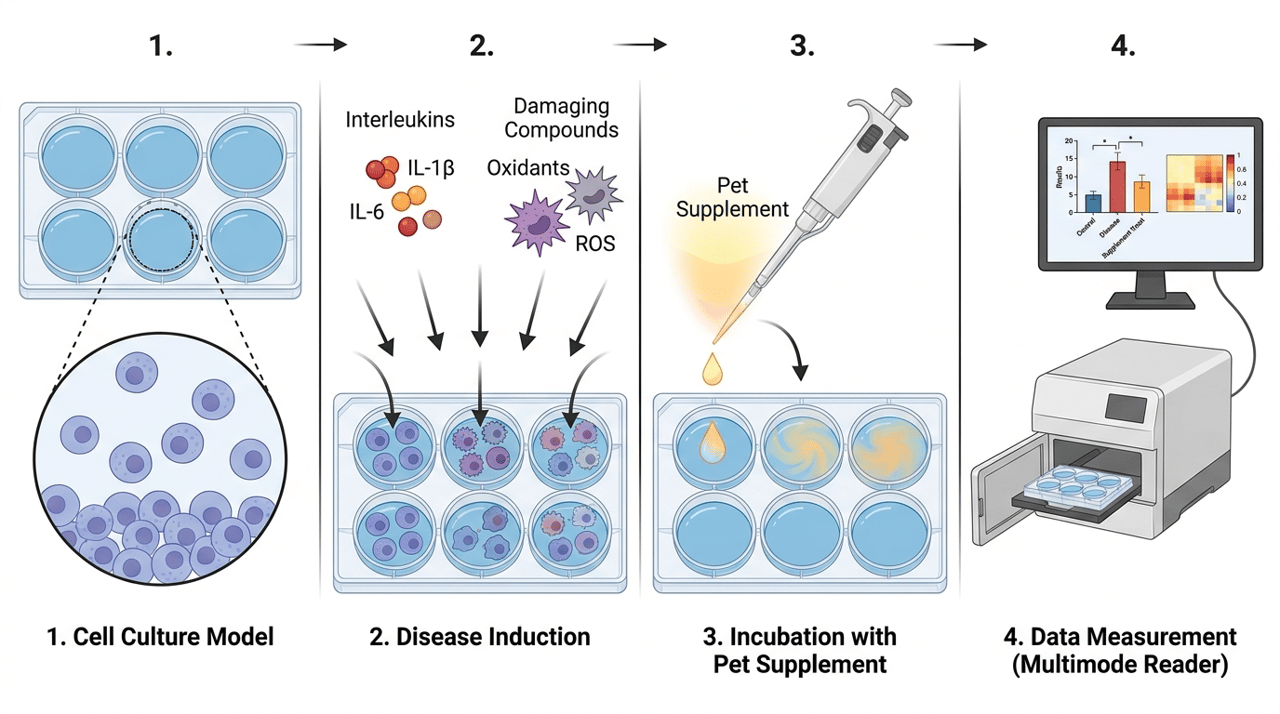
Study methodology diagram
How we work together
  1. 01Free

    Intro call

    We pin down what you want to prove.

  2. 02Paid

    Study plan

    Literature review + experimental options, yours to keep.

  3. 03

    Scoping call

    We walk the options — cost, timeline, power.

  4. 04

    Decision

    Run it or not. Plan fees credit against the project.

€

Full study €10,000–€30,000, Publication-grade Study €30,000-50.000.

Build your study quote today

Pick your species, category, budget, and timeline. We'll handle the rest.

Questions? Contact Us

Which species is the study for?

Some of our projects

A look at the kinds of studies we run, and what the data lets a brand say.

Influence of a joint supplement on cartilage deposition in a 3D cartilage model, with cartilage differentiation and remodeling gene expression by qPCR

A joint supplement tested in a 3D cartilage model to see whether it supports cartilage deposition. Alongside the tissue read-out, qPCR was run on a panel of cartilage differentiation and remodeling genes to characterise the response at the gene-expression level.

What the data supports

A combined tissue and gene-expression picture of how the supplement engages cartilage biology in a 3D model — not a single viability number, but deposition alongside the differentiation and remodeling genes behind it.

Built on Pharma Testing Standards.

Lab4Paws runs alongside veterinary pharmaceutical clients on drug and diagnostic development. The same cell isolation and assay validation standards used there apply to every pet food panel — in-vitro only, no live animal testing at any stage.

Pharma-grade quality testing protocols

Our standards meet the rigorous demands of pharmaceutical development, ensuring your pet food claims are based on the highest scientific integrity.
Pharma and clinical-world insights applied to pet nutrition

In-vitro lab testing only — no live animal testing, ever

Our commitment to ethical and efficient research means all testing is conducted in a lab, providing faster, more reproducible, and humane results.
Ethical, Fast, and Reproducible Results
All our testing is lab-based and in-vitro — meaning we test on cell models, not live animals. This is not only a more ethical approach — it's also faster, more reproducible, and increasingly preferred by regulators and consumers alike.

The Scientists Behind the Study

Davide Confalonieri, PhD
Founder & CEO
Davide is a biotechnology entrepreneur and scientist with a background in tissue engineering, regenerative medicine, and preclinical research. He founded Lab4Paws to close the infrastructure gap in veterinary science — and applies the same scientific standards to pet food claim validation that his lab uses daily for pharmaceutical clients. His experience spans scientific research, international commercial strategy, and building scalable platforms for veterinary preclinical science.
Shrinidhi Thottangal Mohan, MSc MSc
Head of Laboratory Operations
Shrinidhi holds a Master's degree in Microbiology and Molecular and Cellular Biology. She leads laboratory operations at Lab4Paws, specialising in the isolation and expansion of animal primary cells, development of in vitro models, and optimisation of cell culture systems. The biological assays behind every validated pet food claim run through her hands.

Frequently Asked Questions

Find answers to common questions about our testing process, results, and how we can help your brand succeed.
How long does testing take?
What if I don't know which claim to test?
Do I need to disclose my recipe or proprietary formulation?
Is this animal testing?
What if results show something I didn't expect?
Can I test multiple products?
Can a vet use our test results to justify recommending our product?
We want to approach vet clinics or a clinic group. Is this the right starting point?
We does the law requires?

Your product works better.Now go prove it.

  • ✓Takes about two minutes
  • ✓No formulation disclosure needed
  • ✓We test finished products, not isolated ingredients
Build your Study ProposalQuestions? Contact us